
Get In Touch
2026.06.30
Posted By: Peter
You've watched children in a well-designed play space. They climb, slide, jump, and interact. They negotiate turns, solve problems, and test their limits. What looks like simple fun is actually a complex developmental process — one that builds the skills children need for school and life.
Indoor playground equipment is more than entertainment. It's a developmental tool that supports physical, social, emotional, and cognitive growth. Research shows that children learn to think through doing and talking — active play is how young children develop the skills they need. Commercial-grade indoor playgrounds combine climbing walls, ninja courses, obstacle courses, soft play zones, and interactive elements into engaging environments that promote development. This guide covers how different types of indoor playground equipment support child development — from muscle control and coordination to problem-solving and social skills.
Physical play is the foundation of child development. Indoor playground equipment provides safe, structured environments for children to develop essential motor skills.
Climbing walls, ninja warrior courses, and multi-level structures develop large muscle groups. Climbing requires children to coordinate their arms and legs, building strength and balance. Ninja courses test speed, agility, strength, balance, and overall fitness. Slides teach body awareness and spatial orientation. Jumping and bouncing on trampolines or soft play surfaces develops coordination and cardiovascular fitness.
Climbing holds, rope courses, and interactive panels develop fine motor skills. Gripping handholds builds hand strength. Balancing on beams or stepping stones develops coordination. Manipulating interactive puzzle elements, matching panels, and movable blocks builds dexterity. Obstacle courses with multiple difficulty levels challenge children to refine their motor control.
Tunnels develop spatial orientation — children learn to navigate through confined spaces. Ball pits provide sensory feedback that helps children understand their position in space. Sandpits and ball pools are designed with ergonomic layouts to maximize accessibility. Soft, cushioned equipment like foam mats minimizes injury risks so toddlers can explore freely and build confidence.
Play is how children learn to think. Indoor playground equipment creates opportunities for cognitive growth.
Obstacle courses and adventure mazes combine physical activity with mental challenges. Interconnected tunnels, bridges, and hidden passageways stimulate curiosity and problem-solving skills. Children must strategize to conquer obstacles, decide which path to take, and adapt their approach when something doesn't work. Interactive puzzle elements — matching panels, treasure chests, movable blocks — enhance the experience.
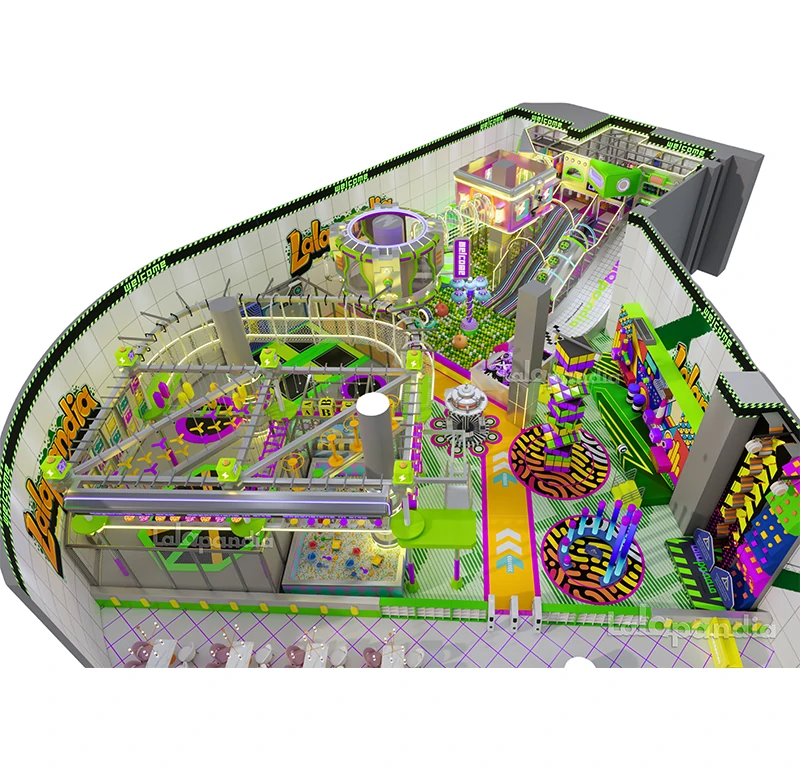
Themed play environments — castles, jungles, space stations, urban punk — spark imaginative play. Children create stories, assign roles, and build narratives around their play. Imaginative play builds vocabulary, narrative skills, and flexible thinking. Themed structures include modern, jungle, ocean, space, castle, candy, and urban adventure themes.
Ninja warrior courses and interactive obstacle courses require sustained attention. Children must focus on the task at hand — whether it's navigating a rope course, completing a climb, or working through a maze. Smart interactive technology with sensor-activated challenges — lights flashing when kids jump over laser beams, sound effects celebrating successful coin collection — maintains engagement and reinforces learning.
Children learn to socialize through learning experiences with other children and adults. Indoor playground equipment creates the conditions for social and emotional growth.
Multi-user slides, group obstacle courses, and interactive team missions require collaboration. Children learn to take turns, share space, and work together toward common goals. The maze design encourages teamwork, allowing kids to navigate it with friends or siblings.
When children successfully climb to the top of a structure, complete an obstacle course, or master a new skill, they build confidence. Progressive difficulty in obstacle courses — lower climbing walls for younger kids, spinning platforms for older ones — ensures children can succeed and build on their achievements.
Soft, cushioned equipment minimizes injury risks so children can explore freely. Rounded edges, non-slip surfaces, and cushioned joints ensure injury-free play. This safe environment allows children to take risks, test their limits, and learn from both success and failure — building resilience and emotional regulation.
Below is a quick reference table for development areas and play elements:
| Development Area | Play Element | How It Helps |
|---|---|---|
| Gross motor | Climbing walls, ninja courses, trampolines | Builds strength, coordination, balance |
| Fine motor | Climbing holds, interactive panels, rope courses | Develops grip strength, dexterity |
| Sensory | Ball pits, tunnels, sandpits | Builds spatial awareness, tactile processing |
| Cognitive | Mazes, obstacle courses, puzzles | Develops problem-solving, planning |
| Creativity | Themed environments (castle, jungle, space) | Sparks imagination, narrative skills |
| Social | Multi-user slides, team missions | Builds turn-taking, cooperation, communication |
| Emotional | Progressive difficulty challenges | Builds confidence, resilience |
Q: How does indoor playground equipment support child development?
A: Indoor playground equipment supports development through physical activity, social interaction, and cognitive engagement. Climbing builds gross motor skills and coordination. Interactive elements develop fine motor skills and problem-solving. Themed play environments encourage imaginative play and communication. Ball pools and tunnels develop spatial awareness and sensory processing.
Q: What safety standards should the equipment meet for a child development setting?
A: Look for EN1176 (European playground standard) and ASTM F1918/F1487/F2970 (U.S. standards) compliance. Equipment should be certified by a globally recognized third-party inspection body and meet EN 71-1, EN 71-2, and EN 71-3 for material safety. Fire-resistant materials should meet UL94 standards.
Q: What age groups does indoor playground equipment serve?
A: Equipment is available by age group: toddlers (1-3) with soft play sets, mini slides, ball pits, and low-height climbers; preschoolers (3-6) with multi-level soft play areas, trampolines, playhouses, and indoor climbers; and older children with ninja courses, climbing walls, and obstacle courses. Age-appropriate zoning ensures safety and provides suitable developmental challenges for every visitor.
Leading manufacturers design, produce, and install commercial indoor playgrounds with a focus on safety, quality, and child development. The design process considers the purpose of the play and how it benefits children. As part of the design, clients have opportunities to influence scale, content, themes, objectives, and learning opportunities.
The equipment is built with galvanized steel frames, soft PVC covers, and high-density foam padding — all EN1176 and ASTM certified. Materials include high-density EPE foam blocks with fire resistance meeting ASTM standards, 1000D high-density PVC leather, and UV-resistant plastics. Safety features include rounded edges, non-slip surfaces, and cushioned joints.
Before you invest in indoor playground equipment, consider your development goals. Whether you're building for a daycare center, a school, or a family entertainment venue, the right equipment turns play into growth — building the physical, social, emotional, and cognitive skills children need to thrive.
Ready to explore indoor playground equipment that supports child development? Contact a leading playground supplier for a customized design proposal. Share your space, target age group, and development goals — their team can recommend the right equipment for your specific venue.
GET A QUOTE
 中文
中文 English
 Pусский
 Français
 Español