
Get In Touch
2026.11.23
Posted By: Peter
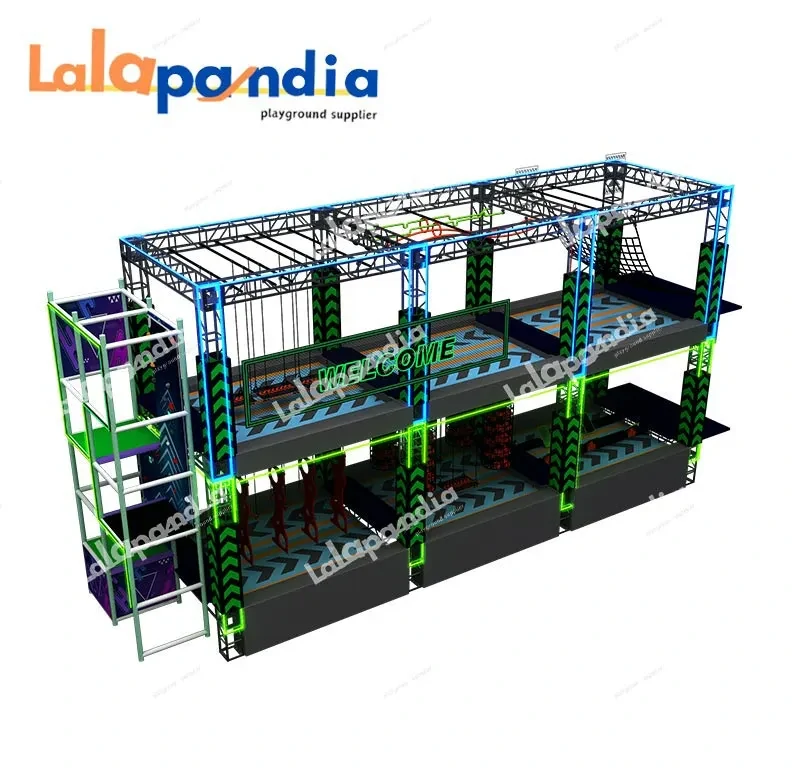
Hanging rings, uneven platforms, a swing bridge, and a drop into a ball pit. Adventure Play in this form runs on a raised, multi-level course built inside a venue, where speed, balance, and agility are tested one obstacle at a time. Here's how the course is put together.
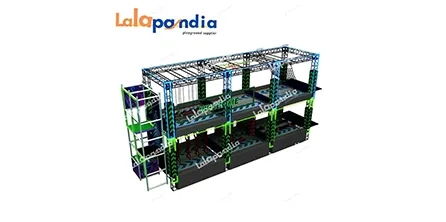
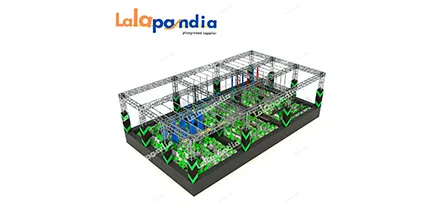
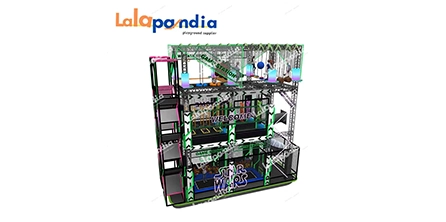
The path strings together four named elements: rope climbing, a swing bridge, a balance platform, and the Ninja Raceway that runs the length of the layout. Around those sit the details that make it feel like the show — hanging rings, uneven platforms, tilted walls, and the suspended paths between levels. A child doesn't climb one thing; they move through a sequence where each station asks a slightly different body action from the last.
Levels run from 1 to 6, so the same concept scales from a small mall corner to a full venue layout. Capacity is split three ways — under 10, 10-50, and 50-100 users — and the equipment is chosen to match the headcount rather than the reverse. The course is built for ages 5+, which sets the height, the gap sizes, and the landing expectation throughout.
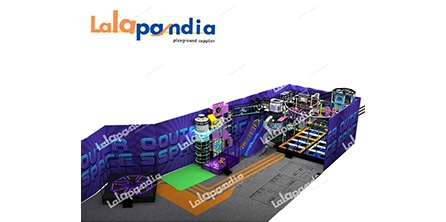
Four solution types are listed: parks, shopping malls, independent amusement park buildings, and large theme parks. Each changes the layout a little — a mall corner reads as a small course, a standalone building reads as a full raceway with multiple levels, and a theme park slot reads as one zone beside other attractions.
A ninja course has drops in it, and the ball pit isn't decoration at the end; it's the landing system for the whole route. That changes how the course is planned: every high station has to know where the body goes when it slips, and the pit's reach has to match the station above it. The course also works two ways at once. A child can race a friend or a family member for the shortest time, the farthest distance, or the first fall into the pit — or race against their own last run, working balance, strength, and speed without anyone else in the lane.
The structure carries a 30cm×30cm thickened connecting aluminum truss with an aluminum base tube, finished in an eco-certified non-toxic color powder coat. That's the part that holds every level, ring, and bridge at its height, and it's the reason the layout can go six stories of elevated stations without a load-bearing wall behind it.
The moving hardware uses a high-strength, corrosion-resistant metal alloy for the buckle and tensile, fatigue-resistant steel wire for the spring, so the stations flex and return instead of wearing loose. Knitted netting supplies the tough, flexible fabric that supports the platforms and absorbs impact, and the cable ties are durable flexible plastic with a strong locking buckle.
Padding and landing surfaces fill the gaps. Sponge blocks and ocean balls are high-density EPE, with fire resistance meeting ASTM standards; safety jumping mats are PP material with a spring cover to prevent injury; the cover is 1000D high-density PVC at 0.45mm thickness, in bright or matte finish, easy to clean and proof against water and oil.
The course is fully customizable across items, theme, size, and location, which matters because an indoor ninja course lives or dies on whether the path fits the floor it's in. On top of the obstacle mix, the customization list covers theme direction, brand colors, an exclusive IP character, and personalized graphic elements; on the space side, it covers custom size, non-standard dimensions, irregular-site optimization, and modular expansion, so a long narrow room, a corner plot, or a square hall each get their own route rather than a rearranged standard kit.
The table groups the headline spec with the material choices behind it, so a buyer can match the venue to the build before any drawing starts.
| Item | Detail |
|---|---|
| Age | 5+ |
| Capacity | Under 10, 10-50, or 50-100 users |
| Levels | 1-6 |
| Recreation elements | Rope climbing, swing bridge, balance platform, Ninja Raceway |
| Frame | 30×30cm thickened aluminum truss, non-toxic powder coat |
| Padding | High-density EPE sponge blocks and ocean balls; ASTM fire resistance |
| Landing mat | PP safety jumping mat with spring cover |
| Cover | 1000D PVC, 0.45mm, bright or matte, water and oil proof |
| Netting | Knitted netting; plastic cable ties with locking buckle |
| Venue types | Parks, shopping malls, independent amusement buildings, large theme parks |
The product carries SGS and EN certification, and the certificate set on file covers the EN 1176 playground series, EN 71 toy safety, and the ASTM F1487, F1918, F2970 series, alongside EN ISO 23659 for trampoline-park safety. These are the reports buyers hand to a landlord, an insurance underwriter, or a customs entry, so it's worth asking which report matches which station before quoting a venue.
The collaboration runs a defined sequence: discuss needs and share cases, review the project in depth, produce 2D layout and 3D concepts, approve the design, confirm materials and the quote, sign and deposit, review site dimensions against engineering drawings, produce with progress updates, test and inspect before shipment, ship, supply certification documents for transport and customs, hand over installation manuals, videos, and team guidance, and finish with an installation check before opening. The last three steps are where a lot of projects stall, and they're the ones the process keeps visible rather than leaving to the installer.
Lalapandia builds the Childrens Indoor Ninja Warrior Course as a modular adventure-play system, with the obstacle mix, levels, capacity, and theme tuned to the venue. Shipping and installation are included with the purchase, along with a 24-month warranty, and the range sits beside related commercial ninja courses, indoor ninja playgrounds, and children's indoor rope courses for projects that want the same challenge across several rooms.
Send these and the concept work starts fast:
An Adventure Play course is matched to the room first, so the dimensions and headcount settle most of the layout before the theme does.
Put the floor dimensions, the age group, and the peak headcount in the first message. Those three decide levels and capacity; the obstacles and theme follow after.
Send them through our request a quotation form and we'll come back with an Adventure Play course planned around your room, your users, and the opening date you're working toward.
GET A QUOTE
 中文
 English
 Pусский
 Français
 Español